Hidden Costs of Hiring a Freelance VA: The Real Math
The rate on the screen says $8 an hour. Twenty hours a week comes to roughly $700 a month. You look at the unanswered emails and the invoices you meant to send on Tuesday, and the hire feels like an easy decision.
The rate is accurate. It is also the only cost that ever appears on an invoice.
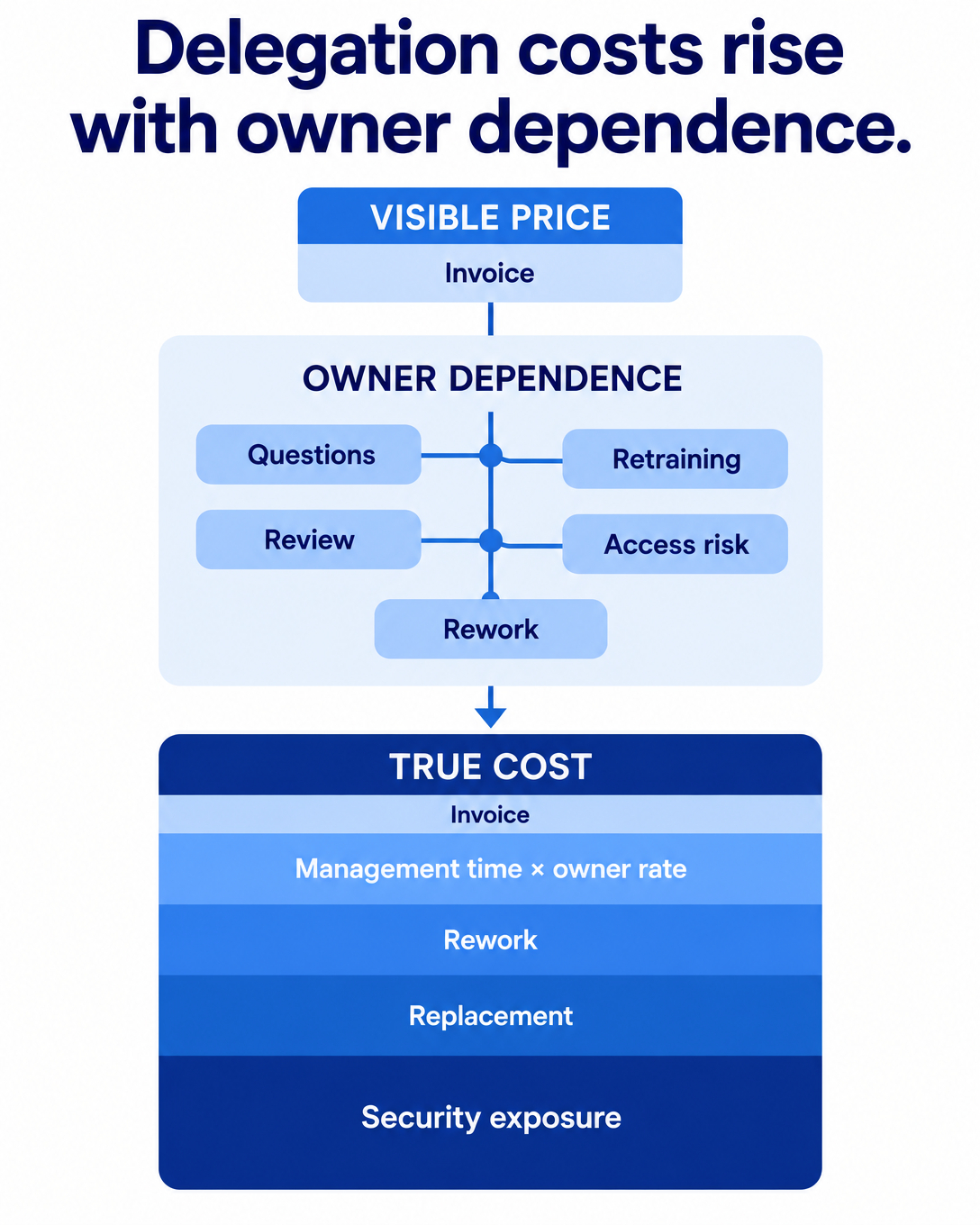
We work with service business owners doing $300K to $3M in revenue, and the same accounting mistake shows up in those conversations again and again. The owner compares the freelancer's invoice to the value of their own time and approves the hire. Over the next six months they pay four additional costs that never appear in writing: management time, rework, replacement, and security exposure.
You pay all four in your own hours, the most expensive hours in the business. This article lays out the full accounting, one cost at a time, with the research that backs it. Run each number against your own situation before you sign anything.
Start With Your Blended Rate
Every figure below depends on one number: what an hour of your time is worth. Take your annual take-home and divide it by the hours you actually work. Revenue alone will mislead you, because take-home depends on margins, payroll, and what you pay yourself.
We use $200 an hour as an illustrative blended rate for an owner working 60-hour weeks. Your number will differ. If it is lower, scale every figure down to match.
The baseline problem is already severe before any hire enters the picture. Survey data shows small business owners spend about 16 hours per week on administrative tasks, close to 36% of the working week. At a $200 blended rate, that is $3,200 a week of owner time spent on work that generates no revenue directly. Hiring help makes sense. The question is what the help actually costs.
Key point: Your blended rate converts hidden hours into dollars. Without it, the invoice is the only number you see, and the cheap option always looks cheap.
Hidden Cost 1: Management Time
A low-cost freelance VA works from exact instructions. You describe the task. They complete it as described, then wait for the next one. Every unclear step comes back to you as a question.
Owners in this arrangement believe they have delegated. They have assigned. They still make every decision and answer every question, on someone else's schedule.
Count the time honestly. Thirty minutes a day answering questions, reviewing work, and re-explaining context adds up to roughly three hours a week once the weekend messages are included. At $200 an hour, that is $600 a week, or about $2,600 a month of your time spent managing someone who bills you $700.
Management alone costs nearly four times the invoice in this example.
The research says that estimate runs low. Sophie Leroy's work on attention residue shows that when you switch tasks, part of your attention stays attached to the previous task, which degrades performance on the new one. UC Irvine research puts the refocus cost at up to 23 minutes per interruption, and context switching costs the US economy an estimated $450 billion annually in lost productivity.
A two-minute question in the middle of an estimate costs two minutes plus the time it takes to find your place again. The American Psychological Association puts the productivity loss from frequent task switching at up to 40%. A workday chopped into fragments produces far less billable work than the calendar suggests.
Key point: Assigning a task leaves every decision with you. In this example, that costs about $2,600 a month, and interruption research shows the true drag on your output runs higher.
Hidden Cost 2: Rework
Without a written process, a freelance VA completes the task the way they think you want it. Assume they guess right 80 percent of the time. The remaining 20 percent comes back wrong, and you usually learn about it from a client.
Take invoicing. One week the invoices go out clean. The next week three carry the wrong PO number, a client calls annoyed, and you lose an hour untangling and re-sending. That hour costs $200 of your time to fix $8-an-hour work.
Two incidents a week puts rework between $400 and $900 a month. In this example, rework alone can exceed the freelancer's entire invoice.
Rework carries a quieter second cost. After enough mistakes, you stop handing over the tasks where errors hurt. Those tasks return to your plate permanently, and a review step gets added on top. The purpose of the hire was to move your hours from $20 work to $200 work. Inconsistent output sends them back the other direction.
Key point: Each mistake costs your time to fix, and enough mistakes move the higher-stakes tasks back to you for good.
Hidden Cost 3: Replacement and Lost Knowledge
Freelance arrangements end often. A better-paying client appears, life changes, or the messages simply stop. The reason matters less than the bill, and you pay that bill almost entirely in your own time.
Count one replacement: write the posting, screen applicants, interview, run a test project, then teach your entire operation to someone new. Fifteen to twenty hours is a conservative estimate. At $200 an hour, one replacement costs $3,000 to $4,000, before counting the work that stalled while you were short a person.
The employment research gives you a benchmark for how expensive this is in general. SHRM estimates that replacing an employee costs between 50% and 200% of annual salary once hiring, onboarding, and the productivity hole of a vacant role are counted. Nationwide, turnover costs American businesses over $1 trillion per year. Freelance churn runs on the same mechanics, with the full burden landing on you because there is no HR department behind the hire.
Each departure also erases the training. The freelancer finally learned how your quotes work, which clients need a lighter touch, and where the signed contracts live. All of it leaves with them, because it existed only in their head. Turnover researchers call this the loss of institutional knowledge, and it is one of the hardest costs to recover.
Two departures a year makes replacement one of the largest lines in your true cost. It never appears on an invoice.
Key point: Knowledge held in one freelancer's head leaves when they do. In this example, each replacement costs $3,000 to $4,000 of your time.
Hidden Cost 4: You Are the Management Layer
When you hire a freelance VA directly, you perform every management function yourself. You chase late work. You catch the errors. When they disappear mid-week during your busiest stretch, no backup exists, because no other person owns keeping the work moving.
Michael Gerber's The E-Myth calls this management by abdication. A task gets handed over with no standard, no definition of done, and no follow-through, and the result surprises the owner. The arrangement fails both sides, because nothing exists to catch the misses.
Consider where the risk went. You wanted out of the bottleneck because the business stopped whenever you stopped. One unmanaged freelancer moves that single point of failure onto someone with less at stake in your business than you have. The structure remains as fragile after the hire as before it.
This is why we build pods. Each client gets a point assistant, specialists, and a pod manager who reviews the work. Coverage is part of the design. When one person is out, the work continues, and someone other than you is accountable for it.
Key point: A single unmanaged freelancer relocates the single point of failure. A structure with a manager and backup coverage removes it.
Hidden Cost 5: Security and Accountability
To do the work, a freelance VA needs your inbox, your CRM, your invoicing system, and sometimes client files. In many marketplace hires, that access changes hands as a shared password in a chat message.
For a pressure washing or landscaping company, the exposure includes payment details and customer addresses. For a CPA, attorney, or title office, confidentiality is the product, so an access failure can damage the practice itself. Regulatory load makes this heavier: small businesses already face more than 379 hours of regulatory paperwork each year.
This cost behaves like a probability. It sits at zero for months and lands hard in the one month it hits. A sound setup has four parts:
You own every account.
Each person has a unique login with permissions you can revoke.
Credentials move through a password manager.
An NDA backs all of it.
In a direct freelance hire, building those four pieces is your job. Price that work into the comparison.
Key point: Security risk rarely registers month to month, so it drops out of the math. In a direct hire, the safeguards exist only if you build them.
The Full Column, Added Up
Here is the illustrative total using the assumptions above.
Freelance VA invoice: roughly $700 a month.
Owner management time: roughly $2,600 a month of your hours.
Rework: $400 to $900 in a typical month.
Replacement and churn, amortized across two events a year: $500 to $650 a month.
Security exposure: unpriced until the month it lands.
Illustrative total: $4,200 to $4,850 a month.
These are hypothetical estimates built on stated assumptions. They are typical of nothing and guarantee nothing. Swap in your own figures before drawing a conclusion. Divide the total by the tasks completed right the first time, and the real rate on an $8-an-hour hire lands far above $8.
When a Freelance VA Is the Right Choice
To be fair about where the line sits, a freelance VA delivers real value under three conditions:
Your processes are written down well enough for someone else to follow.
The work carries low sensitivity.
You have real weekly time to manage a person directly.
Owners who meet all three often get strong results from a good freelancer.
The model breaks down when the process lives only in your head. Then the hire adds a manager's job to your week, because you remain the system the new person depends on. A managed service solves a different problem: the knowledge gets documented, the assistant reports to a manager who is someone other than you, and the work continues when any one person changes. Comparing the two options on hourly price alone produces the wrong answer, because they are different products.
What to Do Before You Hire
Before you commit to any support model, check whether your business can hand off work cleanly at all.
Pick one recurring workflow and write it down this week, from trigger to finish. New inquiry to booked appointment works. So does invoice sent to payment logged. Mark every step that currently requires your judgment.
Count the marks. That number tells you how much management any hire will need from you.
Then run the comparison properly: total cost against total cost, with your blended rate applied to every hour you will spend managing, fixing, and replacing. The cheapest option on paper usually looks different after that exercise.
A documented, managed system removes the dependence on any single person, because the process, the accountability, and the continuity live in the structure. You stay informed without holding everything together personally. Before hiring another VA, find out whether your business is ready to delegate. Go Task-Free's free VA Readiness Assessment shows where your processes are thin and what kind of support fits your business right now.
Key Takeaways
The invoice for an $8-an-hour freelance VA shows one cost out of five. You pay the other four in your own hours.
Calculate your blended rate first. It makes the hidden costs visible.
Management time is the largest hidden line in this example, about $2,600 a month, and attention residue research shows interruptions cost more than their visible length.
Replacement runs $3,000 to $4,000 per event in this example, consistent with turnover research putting replacement at 50% to 200% of salary.
Freelance VAs fit owners with written processes, low-sensitivity work, and time to manage.
Document one workflow before hiring anyone. The judgment calls in it show how much management the hire will need.